

Science attempts to study everything that happens on our planet, both in the present and the past, and to predict the future. One branch of science that studies trees is dendrology . This branch studies trees and their growth, specifically the formation of rings.
In this article we are going to tell you everything you need to know about Dendrology, its characteristics and importance.
What is Dendrology
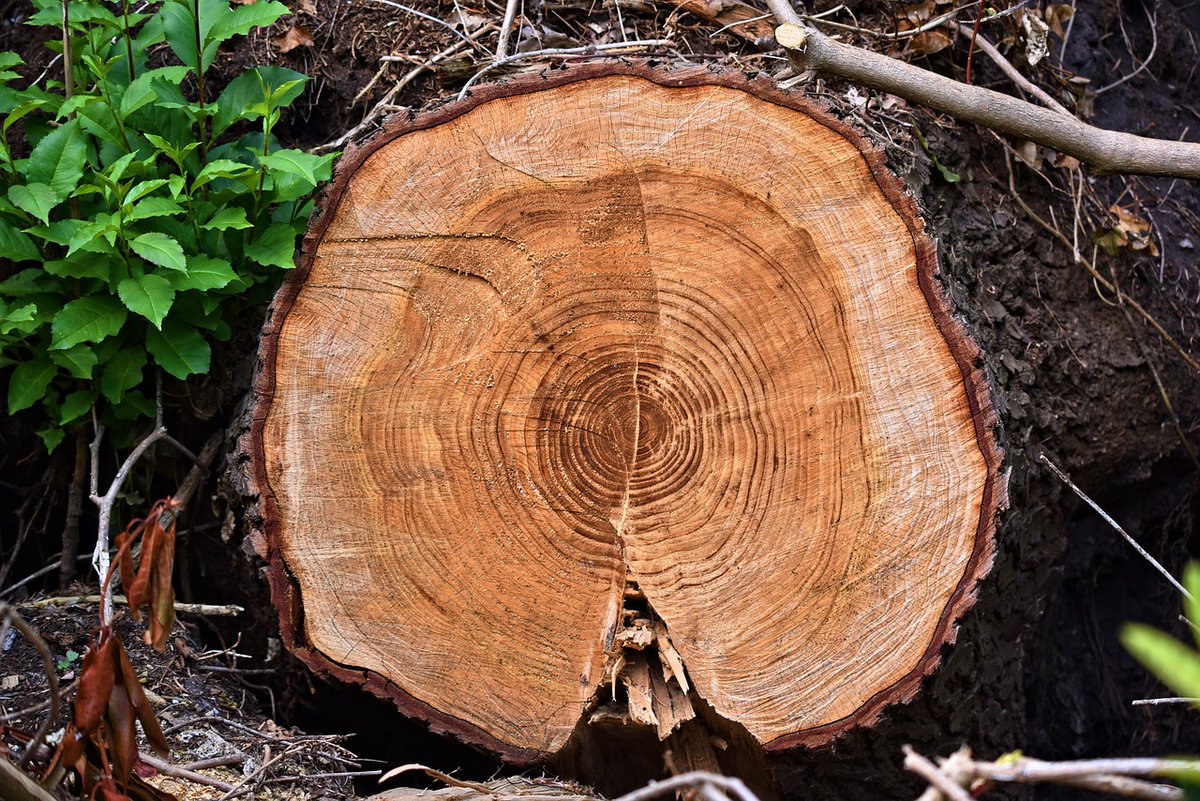
We're talking about the Greek terms "Dendron" and "Logos," which mean tree and study, respectively. The term "Dendron" was coined in 1668 by Ulisse Aldrovandi (an Italian naturalist and founder of the Botanical Garden of Bologna) with the publication of his work, Dendrologia. As a tree grows, it generates new rings. These rings help identify the years of growth, the tree's age, orientation, and other characteristics. Therefore, by carefully studying tree rings, we can gain a comprehensive understanding of what has happened in the past.
Thanks to dendrology, geological processes can be studied through tree rings. The geology of the land changes over time due to external geological agents. Water, wind, rain, and other geological agents shape the landscape. Geological elements such as rocks and their formations are altered over time. By studying tree rings, we can understand what has happened in the past. The study of geological processes through tree rings is a branch of dendrology known as dendrogeomorphology.
This is a significant source of data for territorial, urban planning, infrastructure, and natural resource management studies. It's crucial to understand that all these types of human activities require knowledge of the terrain and its evolution. In other words, for urban development or infrastructure projects, understanding the history of the site where construction is planned is invaluable. The same applies to the existing flora and fauna species in that area. The collection of all the studies necessary to carry out construction in accordance with legal requirements is known as an environmental impact assessment. Dendrology plays a significant role in these environmental impact studies.
Dendrology applied to climate

We know that tree rings provide information not only about changes in the geology of the land, but also about the climate. Although most people think that counting tree rings can tell us the age of a tree, this isn't entirely accurate. Each tree has a different growth pattern, and it depends on the species. Not all trees form the same rings or grow in the same way. Therefore, the formation of these rings can also give us information about the climate that prevailed during the time the particular tree grew.
The dark rings form during the winter time. It is a denser and more compact wood that serves the tree to be able to defend itself against the lower temperatures. Plants must survive harsh environmental conditions in both winter and summer. These are usually two seasons of the year whose environmental conditions are more extreme and, therefore, they need to create mechanisms of defense adaptations.
One of these characteristics is thicker wood, reflected in the darker growth rings. This results in lighter rings in summer, when the wood is less dense, and darker rings in summer, when the wood is denser. The lighter rings are wider because the tree enjoys favorable temperatures and nutrients. This increased plant activity allows the rings to widen over a longer period.
On some occasions we can find clear rings that are very narrow. This may be a sign of historical droughts. Having no water, the tree cannot grow. In this way, we see that the growth ring is quite narrow but still clear. This is not revealing various types of information. On the one hand, the fact that the ring is clear is not revealing that there have been continuous high temperatures. On the other hand, we are seeing that by not growing and being narrow compared to the other wide clear rings, it indicates that the tree has not enjoyed the nutrients.
The presence of narrower or wider rings typically indicates the amount of nutrients available in the environment. A tree with very wide, dark rings reflects long and harsh winters. Similarly, the width of light rings is also analyzed. This allows us to determine whether summers have been longer or shorter and whether they have had high or low temperatures.
Climate change and tree rings
Climate change is not only studied by the increase in greenhouse gases and changes in temperature at a global level. It can also be studied through bioindicators known as tree rings. Dendrology is responsible for studying fossil trees that also provide information about the climate of past eras. In this field we know that it is known as dendroclimatology.
We must bear in mind that the study of climate change is fundamental for the management of natural resources, both now and in the future. We cannot plan our future economic activities based solely on the study of the present. It is necessary to understand the different climate fluctuations that have occurred throughout the planet's history. These fluctuations can be understood quite well thanks to dendrology. Tree rings can reveal a wealth of information, not only about temperatures and tree growth, but also about the evolution of temperatures and environmental conditions.