

A fractal is a geometric object that can be divided into parts, each similar to the original object. Fractals have infinite detail and are often self-similar and scalable. In many cases, fractals can be generated through repetitive patterns, recurring processes, or iterations. If you're interested in learning more about snow and its formation , this relationship is also relevant to better understanding this phenomenon.
Properties of fractals
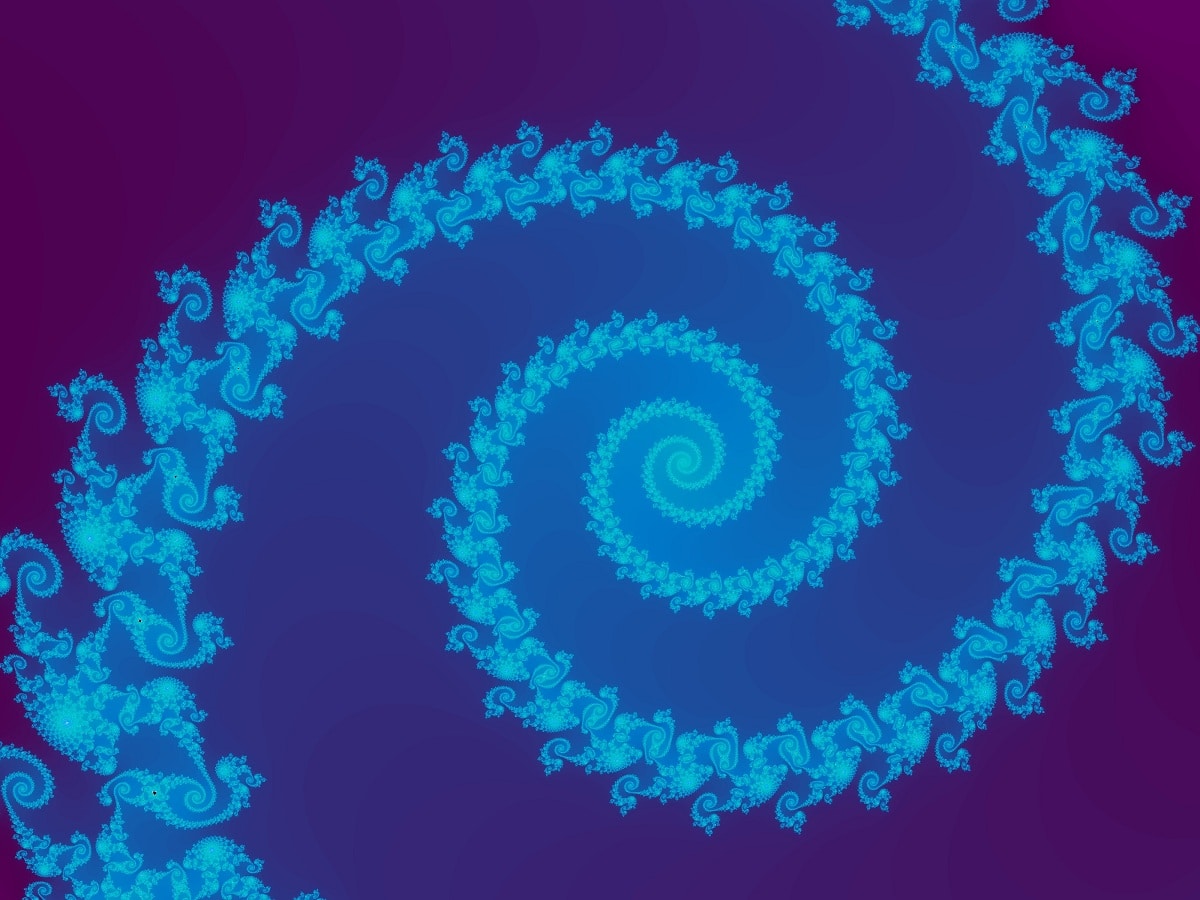
The main properties that characterize fractals are self-similarity, infinite complexity and dimensionality.
self similarity
Self-similarity occurs when a part of a figure or contour can be seen as a replica of the whole, on a smaller scale, resulting in a structure that reflects similar patterns found in nature . This relationship can be observed in natural phenomena where patterns repeat, such as fractals in snow. Furthermore, this self-similarity is key to the study of snow and its formations.
infinite complexity
This refers to the fact that the graph formation process is recursive. This means that when a procedure is executed, it is found that the previously executed procedure is itself a subprocedure within its own procedure. This concept is fundamental to understanding the characteristics of fractals and their fractal structure.
It is worth noting that in the case of the iterative construction of a mathematically defined fractal, the program to be executed is infinite, which results in an infinitely complex structure.
Dimensions
Unlike Euclidean geometry, the dimensions of fractals are not necessarily integer values. In this branch of mathematics, points have zero dimension, lines have one dimension, surfaces have two dimensions, and volumes have three dimensions. In the case of fractal dimension, this is a fractional quantity that represents how well a structure occupies the space that contains it.
examples of fractals

The first fractals studied were the Cantor set, the Koch snowflake, and the Sierpinski triangle. Fractals can be obtained geometrically or stochastically through recursive processes and can take on the characteristics of different types of shapes found in nature.
Fractals exist everywhere . Many natural objects are considered natural fractals due to their behavior or structure, but these are finite fractals, which distinguishes them from mathematical fractals created by recursive interactions, such as clouds and trees. If you wish to delve deeper into other natural phenomena, you can consult about the influence of [unspecified factor].
Key features
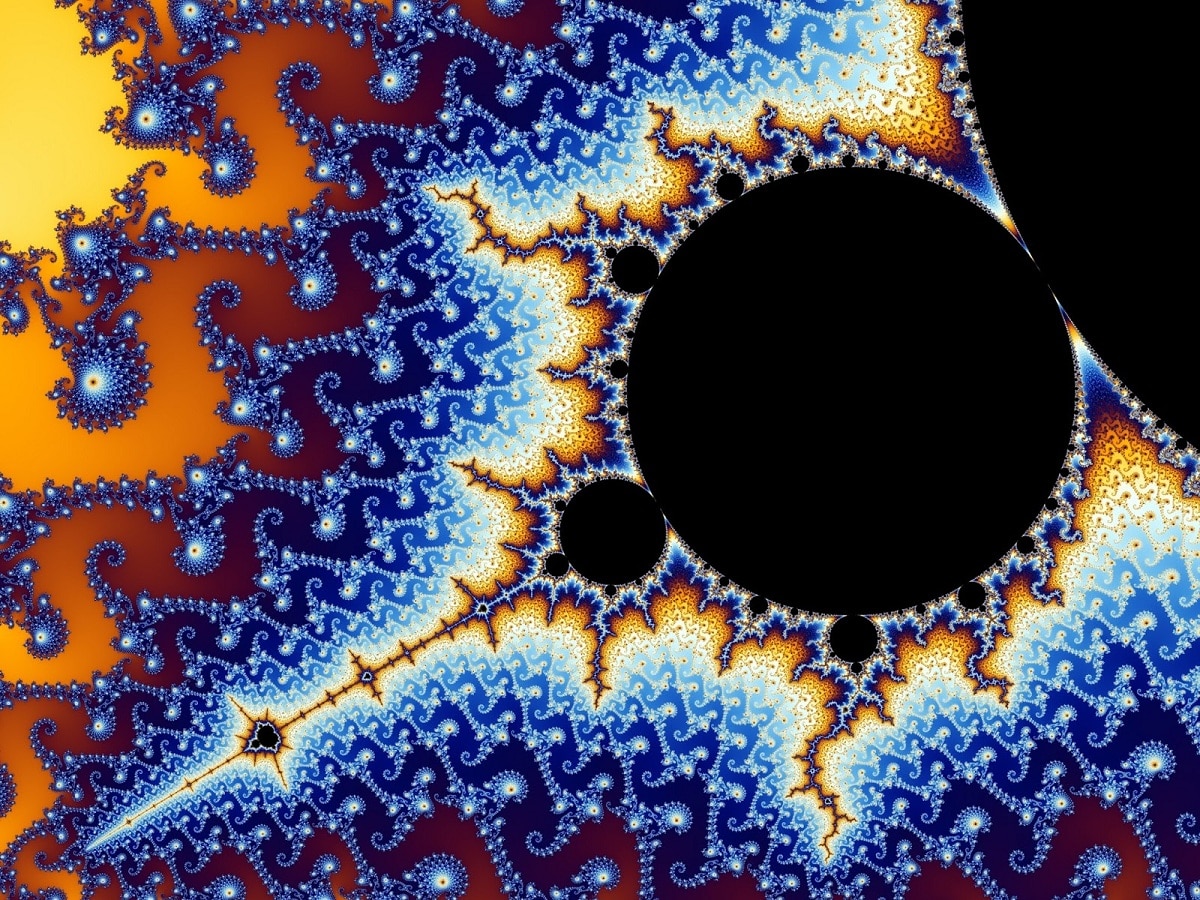
The word "fractal" comes from the Latin word fractus, meaning "fragmented," "broken," or simply "broken" or "broken," and is very fitting for objects with fractional dimensions. The term was coined by Benoît Mandelbrot in 1977 and appeared in his book Fractal Geometry of Nature. The study of fractal objects is often called fractal geometry.
A fractal is a mathematical set that exhibits self-similarity at any scale, and its dimensions are not integers, or if they were, they wouldn't be ordinary integers. The fact that it is self-similar means that the fractal object is independent of the observer; that is, if we take any type of fractal, we can verify that when we zoom in twice, the pattern is identical to the first. If we zoom in by a factor of 1000, we observe the same properties, so if we increase the magnification by n, the pattern remains the same, meaning the part is similar to the whole.
A collection or object is said to be fractal when it becomes arbitrarily large as the scale of the measuring instrument decreases. Many ordinary objects are considered natural due to their structure or behavior , even if we don't recognize them as such. Clouds, mountains, coastlines, trees, and rivers are all natural fractals, although finite and therefore not ideal, unlike mathematical fractals, which are infinite and ideal.
Fractals and science
Fractal art is closely related to mathematics, especially geometry, since, as its name suggests, it uses the concept of fractals. Fractals are based on the constant repetition of a self-correlated geometric pattern, that is, the part is equal to the whole.
To construct a Sierpinski triangle, starting with an equilateral triangle, take its midpoint, form a new equilateral triangle, and remove the center triangle. Then do the same with each remaining triangle, and so on, which is why it's considered a fractal. Benoit Mandelbrot, who discovered the mathematical forms known as fractals, died of cancer at the age of 85. Mandelbrot, a French-American citizen, developed fractals as a mathematical method for understanding the infinite complexity of nature.
To address the classification from general to specific, we can divide them into two broad categories: deterministic fractals (which can also be algebraic or geometric) and nondeterministic fractals (also known as stochastic fractals). If you'd like to learn more about their application in science, you can read about .
Linear fractals are those that are constructed as scales vary; that is, they are identical at all scales. Nonlinear fractals, on the other hand, result from complex distortions, or as their name suggests, to use a term from chaotic mathematics, nonlinear distortions.
Daily life
Most purely mathematical and natural objects are nonlinear. In mathematics, self-similarity, sometimes called self-similarity, is a property of an object (called a self-similar object) in which the whole is exactly or approximately similar to the same part, for example when the whole has the same as one or more in the shape of its parts.
A fractal is characterized by a perimeter that tends toward infinity as it adds increasingly smaller details with successive iterations . However, this curve does not overlap with any time constraint of the circle that circumscribes the initial triangle. Clouds, mountains, circulatory systems, coastlines, and snowflakes are all natural fractals. This representation is approximate because the properties of ideal objects, such as infinite detail, have limitations in nature.
Fractal geometry attempts to model and describe many natural phenomena and scientific experiments, and in just a few years it has become a multidisciplinary tool used by scientists, doctors, artists, sociologists, economists, meteorologists, musicians, computer scientists , etc.

Table of Contents