

Volcanoes are among the most impressive geological formations, although their eruptions can sometimes endanger surrounding populations. There are many significant volcanic regions on Earth, and some craters are active. Therefore, it's important to understand all the related terms to better contextualize these concepts. For example, what is lava , how is it formed, and how does it differ from volcanic magma?
In this article we are going to tell you what lava is, what its characteristics are, origin and differences with magma.
what is lava

Inside the Earth, the heat is so intense that the rocks and gases that make up the mantle melt. Our planet has a core made of lava. This core is covered by crust and layers of hard rock. The molten material that forms is magma, and when it is pushed toward the Earth's surface, we call it lava. Although the two layers of crust and rock are different, they are both constantly changing: solidified rock becomes liquid and vice versa. If magma seeps through the Earth's crust and reaches the surface, it becomes lava.
For all these reasons, we call the magma material that has erupted from the Earth's crust and spread to the surface lava. Lava has a very high temperature, ranging from 700°C to 1200°C. Unlike magma, which cools quickly, lava is denser and therefore takes longer to cool. This is one of the reasons why it is very dangerous to approach the site of a volcanic eruption, even after only a few days. To better understand what lava is and how it differs from magma, it is also important to learn about volcanic activity in Indonesia.
Types of lava flows

When we talk about lava, we're actually referring to lava flows, which are layers of liquid lava that form when a volcano erupts. In this scenario, the most common image is that of a terrestrial volcano spewing a relatively soft layer of lava that slowly flows down the slope.
However, there are different situations that produce different types of lava, such as fissure lava. In these cases, the lava layer expanded and covered a large river-like area, unlike the previous case.
Many factors affect the type of lava that is erupted, such as its composition, which affects its appearance when it hardens. Therefore, there is a classification system that divides it into different types of lava. For more information on the various types of lava flows, you can read about the longest lava rift in history.
The classification is based on their surface morphology and largely depends on their composition and viscosity, which we will examine below:
block casting
This type of lava gets its name from its lumpy appearance. This is because its ingredients are more acidic than usual, making it less fluid. These lava flows accumulate because they are less mobile and form clumps. The blocks are irregular and elongated and do not have a sandy appearance. They are lava flows that contain a high amount of silica.
In this case, the lava is somewhat liquid, viscous and difficult to remove, so it forms lumps as it tends to stagnate and break, resulting in lumps. It also has an important effect on the sudden discharge of lava, which favors the appearance of these faults. Another consequence of this viscosity is that it hardens quickly.
AA Laundry
These lavas are closely related to massive lavas, as many classifications place them in the same category. Their unique name is derived from the Hawaiian word meaning "rock with pristine lava ." They also form clusters with flat, uneven surfaces. These blocks are called clinker.
This type of lava differs from the previous one in that its composition is less acidic, which allows it to flow more easily and gives it a less rough appearance. It is basaltic and forms rough, irregular clumps. Its flow rate is very slow, between 5 and 50 meters per hour. This slow movement results in a chaotic and confusing final appearance. To learn more about this phenomenon, I invite you to read about the differences between magma and lava.
Pahoehoe Laundry
These types of lava are fundamentally formed and have the ability to travel long distances. His name also comes from the Hawaiian word meaning "cute." Also called a wire mold, because it looks like a set of arranged strings.
This formation is due to a phenomenon similar to the previous case. Here, too, the surface of this type of lava cools first, and beneath this layer, the lava continues to flow in a liquid state. In this case, the difference lies in the lava's viscosity. Due to its lower viscosity and fluidity, it doesn't destroy the surface solids but rather deforms them, resulting in a series of waves on the surface that reflect the fluidity of the lava produced within.
pillow lava
Insulating lava is a layer of lava that solidifies underwater. They get their name from the fact that they actually resemble pillows, stacked on top of each other.
Its shape is round, but many different forms exist: block, spherical, tubular, etc. While they are similar in appearance, they vary greatly depending on the type of lava and the conditions under which condensation occurs. Although cooling was almost instantaneous, the surface was not smooth, with wrinkles, cracks, grooves, and many right-angled breaks.
Differences between lava and magma
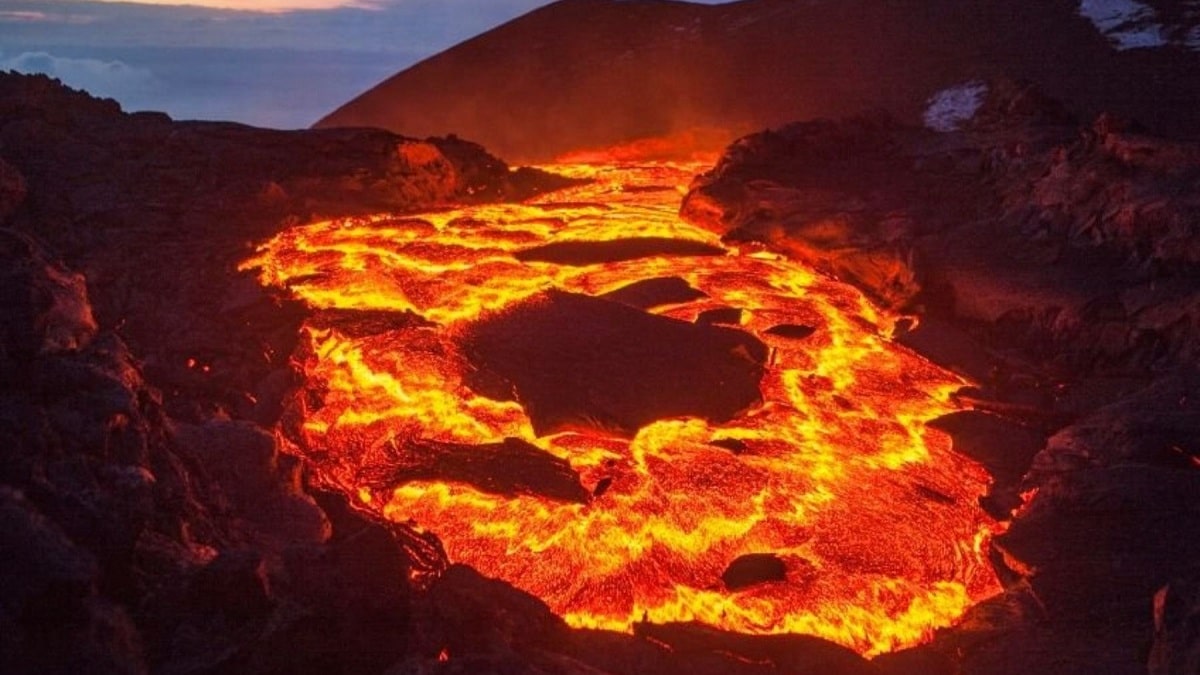
Basically, you might think that lava and magma are the same thing, but they're not. First, the closer to the Earth's core, the greater the pressure. Therefore, the higher the pressure, the more gas is in its composition, and the more gas is released to the surface. It also has low temperatures, comes into contact with the atmosphere or water, and once underwater lava is released, it eventually solidifies, at which point it ceases to be lava and becomes volcanic rock. Although magma and lava are sometimes used interchangeably, they are actually two different terms. Both are related to volcanoes, but they describe two different processes.
Magma is the name given to the layers of molten rock in the Earth's crust that are exposed to extreme temperatures. It is made up of liquid, volatile and solid particles. When magma cools, it becomes igneous rock, which can be divided into two types based on its location:
- Plutonic: If it is inside the bark.
- Volcanic: If the magma melts and rises to the earth's surface.
Lava is a natural geological phenomenon that has shaped many of the world's islands, such as the Canary Islands, through continuous volcanic eruptions and lava flows over thousands of years. To learn more about this process, you can read about what happens when lava reaches the sea.

Table of Contents